Wednesday, June 20

one million VCU sculptures in Chelsea

Kim Foster Gallery


Friends!

Alright, i'm back after a week in New York City and am ready to dump the art upon you. One of the nice things about blogging this show is that some of the photos lost with my stolen computer are repeated here with some of the thesis work of my friends.

Matt Sphar


Rosemarie Padovano


David Herbert

Jnel Iglesias


Ross Caudill

Ben Jones


AJ Liberto


Miriam Ewers

Nathan Carder

Angie


Taylor Baldwin


Unfortunately - besides forgetting Angie's last name (i think its White) and getting a horrible view of Matt's glass surfboard and model ship - i thought i would have more time to get better and more photos of the show by the time i came back down from the painter's gallery so some artists are missing- but this is not the only place to see the show. link to brigham's blog for more >>>>>>>>>>

Friday, June 15

one million sneak peaks into the vcu takeover of chelsea

All this week the painters have been getting the Denise Bibro gallery ready on 20th street, four stories above the street.

Eric Sall, wife Rachel Hayes (her piece in background), and Lauren Clay (her piece in foreground) contemplate the best lighting for Eric's enormous painting.


Andy Kozlowski and his wife, Nicole Andreoni, making one million rolls of blue tape for his now legendary proliferation of graph paintings.


Lauren Clay unruffles her paper feathers

Lauren and Aaron feeling the relief of finding the perfect apartment after days of househunting in Brooklyn.


Heather Harvey gets to stick it to the white box gallery man by drilling one million holes into the wall in the name of Art.


Eric takes care of the lighting.


Meanwhile, downstairs at Kim Foster Gallery, the sculptors flex their 3-D muscles.

Miriam and Ewers and Tim Devoe make a whale.


Jnel Iglesias embeds a video into the drywall


And Angie strings up some ceramic cup fragments to be played by a spinning turntable

The show is tomorrow night!

Monday, June 11

one million art magazine ads

You know that new summer Artforum that's extra thick yet has less articles than usual because its ALL ads? Well, this is one may have seemed not worth your time but I think you should pay special attention to it:


not the chicken part...this part


Come one come all for I shall be showing with my Richmond friends at a Chelsea gallery this Friday.
I blog this minutes before driving the moving truck of art up to New York City with Andy Kozlowski where we will install the show. I'll be there for the week until the show so talk to you then!

Friday, June 8

one million tiny tuttles


I'll be blogging from my camera phone for another little bit here til i upload my new photos from an older camera. This little morsel comes from my layover in New York a week ago - a whole day of a layover with enough time to have Chipotle with Jeffrey, find Cindy, Rebecca, and Jaron at Mood (Project Runway...), and Richard Tuttle at Sperone Westwater. I'll be back in three days so maybe I'll see this show again - totally worth it.

UPDATE
So Tuttle is a favourite artist of mine so you'd think that i get his work. I thought so until just read this artist statement about the show:
"It is my first exhibition using sculptural space in concrete relationships between material and illusion to explore time. Each work has within itself a new definition of matter constructed neither from originary nor non-oringinary time, but from a pre-codified version of ITS time - a ticking clock inside denotes temporality in non-comparable actions."
I need to go back a second time this week...hah second TIME. maybe i'm close to solving this....

Tuesday, June 5

one million hulk smashes in Utah

Hulk Smash II


So I've been in Utah for jaredday 2007 and this is hot off the press from a few hours just tonight thanks to

A. Scientist Elliott Carter Ferris who diligently collected Styrofoam for months from the laboratories of the University of Utah
B. Artist/Designer/Genius Chris Coy who filmed and did all the technical work to get this video on here (see his website and/or blog soon)
C. Universal Post studios in Salt Lake City who let us film after hours
D. Seventy-Sixer Mike "Squarehead" Evans for his film experience and enthusiasm
E. Father John Edward Clark for his wardrobe and his genes which bring the Clark's physical potential close to hulk standards
F. Dumpster Diving and R.C. Willey for extra Styrofoam finds this week
G. Lou Ferigno and the Incredible Hulk


My cameraphonephoto of the Bild


This has been in the works since my friends at home saw the first HulkSmash and we schemed over my Christmas break in Utah on how to film it better. Who knew it would really happen.

Sunday, June 3

one million ways to impede thesis blogging

Dear Reader,

For the three of you who have been reading my thesis chapter by chapter and waiting for more photos and chapters i must apologize. The recent lull in thesis posts is due to the loss of both my camera and my computer, stolen right out of my locked studio, before my trip here to Utah. Before "Studio Stealing Tragedy 2007" I was about to post the photos of the thesis shows of my peers and the second version of my thesis show. While my photos are gone forever and the other shows are over, i should be able to re-take more shots of my second version and find a copy of my thesis to post eventually. In the meantime you can find some recent D.C. and N.Y.C adventures on Cindy's blog.

Saturday, May 26

one million thesis chapters: chapter 6

ONE MILLION PAINTINGS 2005-2007: A THESIS

CHAPTER 6
I Have a Dream


I once met an artist through an altercation. It was at Claremont Graduate University during a VCU group show - an exchange we did in February of 2006. I had taken a photograph of a gallery interior of the show in which she and her peers were conversing in the background. Her friend anxiously pointed out the transgression and she angrily approached me yelling, “Did you take a photo of me? You have to delete that right now!” As I obediently did so the middle-aged conceptual artist explained her lifelong project of prohibiting records of her image and her voice past those that existed from her youth. I suppose it had something to do with mediated memory, mediated identity, and the Fountain of Youth. My project would be the opposite but just as egotistical.
My dream art shows are ones that are impossible to actualize. A favourite is The Incidental Portrait. These are portraits that ‘happen’ when one is accidentally caught, for example, in the background of a tourist’s photograph or filmed on a security camera. If it were possible to obtain every photograph and video clip I would fill a museum with these results of public overlap and surveillance as a massive “incidental portrait”.
Another impossible dream show is The Life Story of Every Thrift Store Object I Have Ever Bought. As an avid thrifter this show would also be huge, for it would showcase each object along with photographs and other documentation of the previous owner’s(‘) use(s) of the object along with documentation of my own use(s) of the same object.
I mention this latter dream to illustrate one of the strategies of infusing content into formalist work. Although the work is abstract, every object used fills the supposedly empty formal void with content. Each found object not only carries a message in its medium and a meaning implied in its function, but also a narrative read from its use. Sometimes we are privy to details of the narrative through clues left by the previous owner. This is particularly true of the kitchen cutting boards I collect whose stains and knife marks reference the owner’s hand and activity. I value these same storytelling marks for their instant transformation into found drawings and paintings when hung on a wall. Furthermore, these narratives become palimpsests as the text of interventions doubles the text of its previous function(s).


I sort of approach a dream artshow here in my thesis show by filling the flat files and filing cabinets with many of the small works and collections. Its organizes the studio and the two years in slices - like a sedimentation of my studio practice that you can pull out in layers from the main rock formed out of the studio. Part of my realization of this metaphor was suggested by Taylor's mountain next to it - and it was reinforced when i recently read Robert Smithson's "Sedimentation of the Mind"
These are actually the framed drawings of me done by my students in Utah


Teddy Bear Limbs


"The Roundies" (the paintings i started in Provo and first worked on in Richmond)

one million thesis chapters: chapter 5

ONE MILLION PAINTINGS 2005-2007: A THESIS

CHAPTER 5
The Tyranny of Choice


Of course the mixed blessing of being a painter in these pluralist post-modern times is that any way of making a painting is valid. Ultimate freedom comes with the price of a stifling quantity of choices. The irony we see everywhere in a world of pluralism is that more choices leads to less confident decision-making. Even when a painter narrows in on the intention to deal with the legacy of abstract painting, how does she justify which colors and shapes and combinations are chosen anymore? I have noticed that contemporary abstract painters turn to systems to justify their decisions.
A common strategy of system painters is to use maps in some way – a zeitgeist I like to refer to as Mapstraction. I am no different than these abstract painters who cast about for systems to generate interesting work, but since my systems use the found object – both as a system to find paint and as a system to find its surrounding elements, (its dimensions, support, and walls) – they are embedded with a critique of the arbitrary nature of much abstract work today.


Bruce Pearson checks out the buttresses.

Bruce was our visiting artist this semester and changed our lives.
This is one of his paintings, "Encyclopedia 3 (relative calm sounds of gunfire and footsteps sadly familiar sheds some light)" courtesey of his gallery, Ronald Feldman. You can also see his gouche work on the Pierogi website flatfiles. The paintings look like line drawings in the photographs but those lines are cut...the paintings are actually made on Styrofoam cut into a relief sculpture and weigh hundreds of pounds when all the painting is done.

Jason Coates, my studio neighbor for these two years (a typical arrival to the studio would sound like this, "morning JC!" "morning to YOU jc."), proudly poses in my show.


He has a great new website: jasoncoates.com and will be moving with the two women in his life - wife Carrie and cat Kevin - up to New York this summer!
This is an old pre-grad school piece of Jason's I've been really excited about since seeing his website:


I had fun defending these things in my thesis defense:
"What are these?"

"Paintings."

Friday, May 25

one million thesis chapters: chapter 4

ONE MILLION PAINTINGS 2005-2007: A THESIS

CHAPTER 4
Notes of a Formalist Apologist


I don’t see a dichotomy with formalism and something else. Form and formal relations are important because they mean something; their meaning grows out of our experience as physical mortal beings of a particular scale in relationship to the world as we find it and make it. I don’t buy that formalism is meaningless.
-Jessica Stockholder


Jessica Stockholder is a modernist painter who works with post-modernist sculpture. At least this is what I argue in a paper, How to Be Everything and Everywhere all at once: The Allegorical Impulse of Postmodernism in the Modernist Paintings of Jessica Stockholder, for a history class covering post-modern painting with Dr. Robert Hobbs. I choose the topic not only because of my interest in her work as “neither painting nor sculpture”, but as a way to understand and critique where my own work lies in relation between painting and sculpture, formalism and conceptualism, and modernism and post-modernism.
Stockholder’s work is clearly formalist and she invites modernist interpretations by ascribing emotional content to the forms. The arguments placing her within formalist and modernist tendencies is not the issue here, more important is the way Stockholder fits within a post-modernist definition. To do so it is helpful to consider Stockholder’s ‘modernism’ in the context of Craig Owens’ landmark ideas surrounding allegory and postmodernism, Owens defines allegory as “one text doubled by another.” It is a contextual doubling, like when the New Testament is read through the text of the Old Testament; and literal, as when old graffiti is read underneath the new tag covering it. More interestingly, then, in allegory is when “one text is read through another, however fragmentary, intermittent, or chaotic the relationship may be.” Owens' most compelling paradigm for allegory is the palimpsest. The palimpsest is the ancient text on animal skin parchment that has been erased or scraped away, yet is still visible through the new text written over it.” Stockholder’s work is allegorical in this way. It is actually a type of palimpsest itself since the handwritten text of painterly interventions are made on top of actual objects and, therefore, on top of the inherent meanings, functions, and connotations of those objects, or their texts. It is as if Jessica Stockholder recognizes the palimpsest in her work when she says,
My work makes use of the state of things. I make my work on top of what is already there…it is an interweaving of how I see things, how other people see things before me and how people see the work after I make it.

Not only do Stockholder’s abstractions succeed in creating palimpsests, but also they accord figuratively with Owens' list of allegorical impulses so closely that we are compelled to change our appraisal of Stockholder as modernist to viewing her work as representative of the Allegorical Impulse of Postmodernism. Owens’ list of impulses includes site specificity, hybridization of art mediums, appropriation, impermanence, and accumulation – all clearly evident in Stockholder’s oeuvre.
Because of her mastery of ‘combine’ technology, Stockholder is often compared to Robert Rauschenberg. The first impression of work by both artists is often of chaos and randomness. Here are two artists whose style is, deceptively, to include ‘everything and anything’. The randomness of Rauschenberg and Stockholder is deceptive as they actually make chaos cohere into an understandable gestalt. The exuberance that Stockholder and Rauschenberg share is the poetry of limitless possibilities. Its consequence is ephemerality - and this is quintessentially postmodern.
It will be shown in this thesis that my own work, which shares tendencies of formalism and ambiguous identity with the work of Jessica Stockholder, develops on a continuum of the allegorical impulses of post-modernism. Like Stockholder, my work avails itself of accumulations, hybridizations of mediums, appropriation, impermanence, and site specificity and, therefore, is formalist work that defies the notion that formalist work is devoid of content.


I think it is time to show you the artwork i shared thesis space with, beginning with the other artist: Taylor Baldwin.

Taylor and I are the only two artists graduating this year who claim the desert west as home (he is from Arizona)...that is Dr. Hobbs in the background (mentioned in the chapter above)

I'm sure you're wanting a better view of the mountain Taylor made:
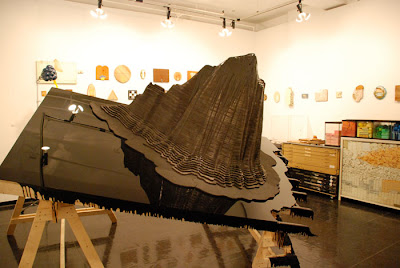
I asked Taylor's permission to pun off his cloud sculpture by placing my cloud/bunny tail cutllage behind it.
He was enthused.


Wednesday, May 23

one million thesis chapters: chapter 3

ONE MILLION PAINTINGS 2005-2007: A THESIS

CHAPTER 3
Minimalist Objects in Maximalist Times


Half or more of the best new work in the last few years has been neither painting nor sculpture…but this work which is neither painting nor sculpture challenges both. It will have to be taken into account by new artists. It will probably change painting and sculpture.
-Donald Judd, Specific Objects, 1965

This prophecy by the formidable minimalist authority Donald Judd remains relevant to what continues to be some of the best new work in the last few years even four decades after its pronunciation. It certainly ignited my own imagination seven years ago as a young painter searching to stretch the limits of painting in his own way. Consider Judd’s own sculptural work. Once his fabricated cubes are viewed in terms of paintings, or the painting object, they are simply steel, brightly colored, broadly proportioned versions of the shallow stretched canvas box – the sculptural qualities of a painting emphasized. Sculptures once labeled as boring because they withstand understanding and bar interest now unfold a side panel to offer an entry point into a dialogue– not the entry point, but an entry point nonetheless. Looking at minimalism through the lens of painting is like highlighting through decoder glasses previously invisible text. Judd’s work is not the only text decoded by the lens of painting among the “neither painting nor sculpture” arts. The earth work of Robert Smithson, the sliced architecture of Gordon Matta Clark, the organic objects of Eva Hesse, the slight of hand of Richard Tuttle, the monoliths of Leonardo Drew, and the installations of Judy Pfaff and Jessica Stockholder exemplify varied and valid responses to the Judd challenge that also excite my imagination when read through my painting lenses.
My own explorations into the space between painting and sculpture were predicated upon meditation of the Judd manifesto combined with a fascination with the dead-end ideas of Clement Greenberg. The fact that the reductive tenents of both minimalism and modernism led to impasses and were often considered bankrupt or unfashionable were the very qualities that made them ideal beginning points. Counter intuitively following closed ideas opened up new forms. I had found that painting in the style of my heroes was the true dead end, and that trying to take work I disliked and make it my own created a friction that could be construed as ‘interesting’. I found the work of Donald Judd boring and been taught to mock the essentialist qualities of modernism but they became, ironically, a genesis of work I would love. My questions centered on: how could I build a new sort of object from scratch – one that was neither painting nor sculpture - yet played with the essentials of painting?
My investigation of the specific object began with a Greenbergian contemplation of what the “scratch” of painting was anyway: wooden stretchers, panels, canvas and white gesso? In exploring these essentials in object making I veered from fabricating with new wood and Styrofoam toward using reclaimed materials scavenged from thrift stores and junkyards, repairing their cracks and dents with Bondo and wax. Thus I not only found creative energy by revisiting discarded ideas, but mirrored this ethic by using discarded materials. In perhaps another modernist gesture of unity, both my concepts and my mediums sought to resurrect and heal the abandoned, the trashed, the junked, the marginalized, the overlooked, the second-hand, the wasted, and the forgotten.
Tongue-in-cheek I called myself a modernist and, although I suspected that making modernist work in contemporary times was a post-modernist activity, I knew that my work was true to its formalist upbringing at Brigham Young University - even though it had begun to look different than any other work from that school. I had been introduced to Judy Pfaff when she came to BYU to do an installation in the Museum of Art on campus and I was excited to see her work with plaster, metal, and found objects through the painter’s lens. Equally thrilling was my secret insight that the installations of Jessica Stockholder were really paintings in real space. I would soon realize that nearly everyone agreed on this point, but it didn’t dampen my excitement that had already been building about the possibilities of “neither painting nor sculpture”.
As I continued to develop my formalist work at Virginia Commonwealth University my connections to minimalism, modernism, the specific object and installation grew into interests with the readymade, kitsch, conceptual art, and site specificity. In other words, I am an artist who finds himself on thresholds: between modernist and post-modernist tendencies and between sculpture and painting; rubbing opposites together to create frictions which could be construed as ‘interesting’.


Chris Coy came to Richmond just in time for the opening.

Chris Purdie also came to Richmond - right after Chris Coy left.

It was a little confusing for some people.

one million thesis chapters: chapter 2

ONE MILLION PAINTINGS 2005-2007: A THESIS


CHAPTER 2

Goals


As a new first-year graduate student, having barely arrived to Richmond from Utah, and still moving into a triangular shaped studio recently vacated by Emily Hall at Virginia Commonwealth University; I found myself lounging on a porch at an opening social in the country home of our chair, Richard Roth, and being asked a very serious question by one of the second year painters:

Jody Schwab: “So what are your goals for your two years of graduate school?!”
Jared Lindsay Clark: “To make one million paintings.”


(Justin and Sara Brockbank visiting the opening of One Million Paintings 2005-2007: A Selection)

Friday, May 18

one million thesis chapters: chapter 1.

ONE MILLION PAINTINGS 2005-2007: A THESIS


CHAPTER 1

When I’m Coming From

June 1st, 1976.

Marilyn Monroe
Brigham Young
Terry Winters
Pat Boone
Nicole Andreoni (Andy’s wife)
Morgan Freeman
Andy Griffith
Aunt Anne
Chris Purdie’s sister
Nanda’s girlfriend, Buck
Amber’s roommate &
Helen Keller R.I.P.
all share my birthday.

I think this kind of explains where I’m coming from.